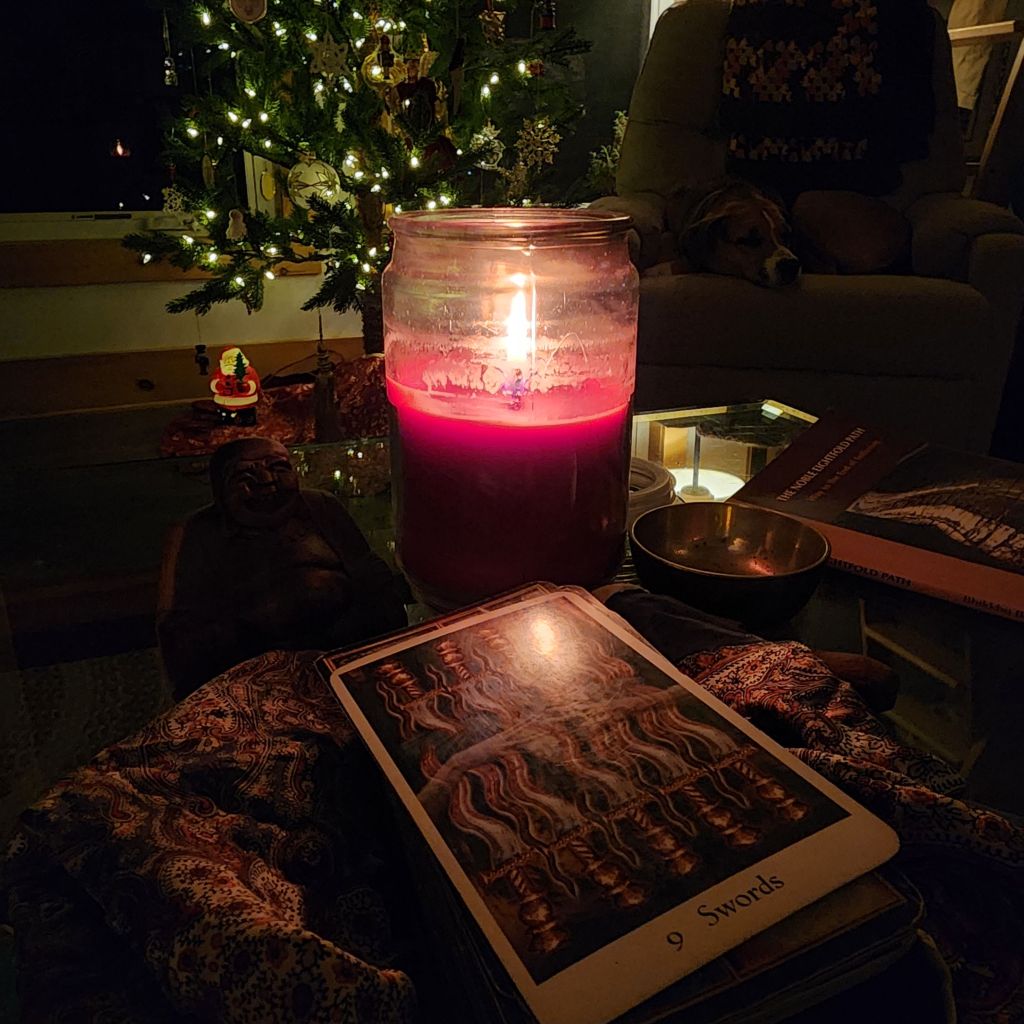
Several months ago, I listened to the audiobook Why Buddhism Is True. The book left me without argument. Yes, Buddhism is true, indeed.
Meanwhile, I had been keeping a morning tarot practice. Tarot isn’t about divination for me. It’s about the human condition. The thing is, I knew little to nothing about tarot—what each card represents, any of it. Zero knowledge. Enter AI.
In my practice, I pulled a card and shared it with ChatGPT, which provided an image description, a traditional meaning, and three to four reflection questions. I’d answer the questions in my journal and then feed my responses back into ChatGPT. Over time, I began to gain insights, notice trends, and identify ideas worth studying.
After encountering Why Buddhism Is True, I came up with Morning Tarot Through a Buddhist Lens. The goal now has an added aspect: teaching me Buddhist practice as I go.
So if you thought, “Oh boy. Learning tarot with AI? Disgrace! Dangerous! Dastardly!” now you might be thinking, “Learning Buddhism with AI? Are you mad?”
Honestly, it’s been wonderful.
Here’s where the morning practice stands now.
I begin with a brief, gentle version of the Five Remembrances. Right after that, I name my current mind state. Then I take a grounding breath.
I draw one card from the Cosmic Tribe deck. ChatGPT describes the card’s imagery first, then gives a straightforward traditional tarot interpretation.
Next, I assign the card to one Noble Truth and one element of the Eightfold Path. There are other Buddhist frameworks I could map a card onto, but for now I’m sticking with the Noble Truths and the Eightfold Path so the practice stays clear and doable.
With those assignments in place, ChatGPT reframes the card through that Buddhist lens.
ChatGPT then provides reflection questions and a short teaching excerpt from a trusted Buddhist source. I journal my responses and share my answers back to ChatGPT.
ChatGPT distills my journaling into one practical next step. Then it closes with a Pocket Pāramī entry—three short lines to carry through the day—and a brief closing reflection or mantra.
On Tuesdays (my day off work), ChatGPT adds four extra prompts: ethics, community, meditation consistency, and whether I’m neglecting any of the Four Noble Truths.
That sounds like a lot. It is a lot. But the whole practice only takes about twenty minutes. Twenty minutes isn’t long, but it’s long enough to interrupt the usual autopilot. It gets me out of my own head and into a clearer relationship with reality. Tarot gives me a mirror. Buddhism gives me a map. ChatGPT gives me structure and puts real teachings in front of me, one small bite at a time.
It isn’t perfect. It’s practice. And it’s working well enough that I’m willing to keep showing up.
In the next post, I want to name what I’ve actually learned—and what’s missing.


 icanhasgrace
Leave a reply to TW Tommy Thompson Cancel reply